
Reading and Writing the Body: The Bioelectric Interface
Updated: Jul 24
BIOELECTRIC TEXTILES · 01
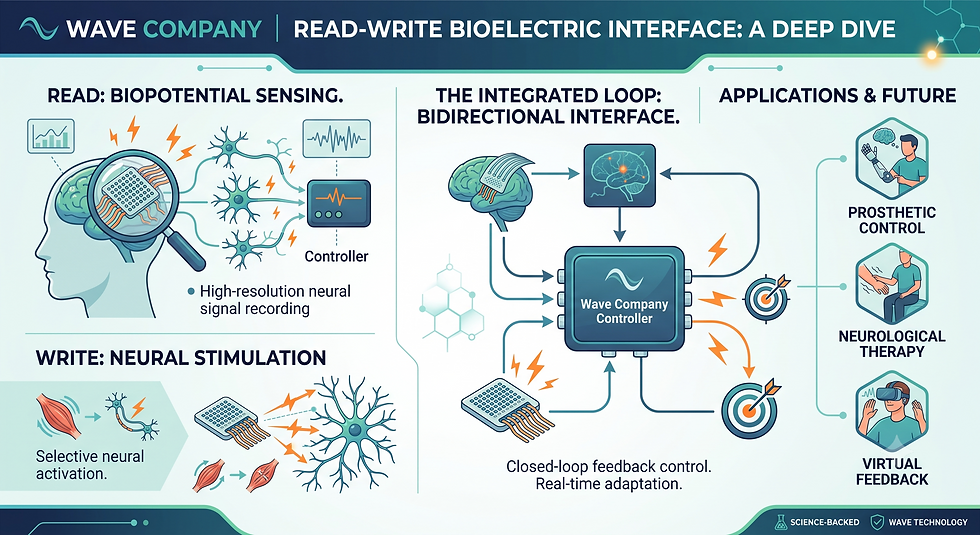
Most wearable health technology is very good at reading the body's electrical signals — but observation is only half of an interface. This article looks at how sensing (READ) and stimulation (WRITE) actually work, how the two can connect in a closed loop, and where a textile electrode platform like ElecSil fits into that picture.
Updated: July 2026

Why is "reading" the body only half of the interface?
Over the past decade, wearable devices have become very good at listening to the body. Heart-rate straps, ECG-enabled smartwatches, EMG armbands, and sleep trackers all share a similar design pattern: capture an electrical signal, process it, and present it back to the user as insight. This is the READ side of a wearable interface, and it has matured quickly, in part because sensing is a comparatively contained engineering problem — a passive electrode, an amplifier, and enough signal processing to filter out noise.
Communication back to the body — delivering a controlled signal rather than only measuring one — is a much less mature part of the wearable landscape. Most products on the market today are built to either read the body or write to it, rarely both, and rarely through the same soft, skin-contact interface. Understanding why requires treating READ and WRITE as genuinely different engineering problems that happen to share the same contact point: the skin.
READ: what does measuring the body's electrical signals actually involve?
Every heartbeat and every muscle contraction is preceded by an electrical event inside the body. Electrocardiography (ECG) captures the heart's electrical activity — the depolarization and repolarization of heart muscle as it pumps. Electromyography (EMG) captures a muscle's electrical activity — the signal that motor neurons send to muscle fibers to produce contraction. In both cases, a sensor placed on the skin is not reading an abstract score like "heart health" or "muscle strength." It is picking up a very small, very fast voltage fluctuation that has traveled from an internal electrical event to the surface of the skin.
Electroencephalography (EEG) works on the same underlying principle, applied to the brain: electrodes detect voltage differences generated by neural activity, in this case at the scalp rather than the chest or a limb. EEG is a more demanding sensing case for a wearable textile electrode than ECG or EMG, since it typically calls for higher electrode density and works with a much smaller signal amplitude — but it belongs to the same broad category of READ technology.
For any of these signals to be usable, the electrode itself has to do far more than make contact with skin. It needs to hold a consistent connection through movement, sweat, and repeated use, without introducing so much noise that it drowns out the very signal it is meant to capture. This is where electrode material and construction — not just the amplifier or the software behind it — becomes a real engineering variable, not an afterthought.
WRITE: how does a system deliver a controlled signal back to the body?
The other direction of a bioelectric interface is WRITE: delivering a deliberately shaped electrical signal to the body, rather than reading one from it. This is the domain of electrical stimulation technologies such as EMS (electrical muscle stimulation), NMES (neuromuscular electrical stimulation), FES (functional electrical stimulation), and TENS (transcutaneous electrical nerve stimulation). Each delivers current through skin-contact electrodes, but the intended purpose, waveform, and context differ: some are associated with eliciting muscle contraction, some with pain modulation, and some with timing a pulse to a specific functional movement, such as a step or a hand-opening motion.
WRITE also extends beyond stimulation aimed at muscles or nerves for training, rehabilitation, or pain management. Electrotactile haptics — small, controlled electrical pulses delivered to the skin to create a sensation of touch or pressure, rather than the vibration used in most consumer haptics today — are being explored as a feedback channel for extended reality (XR) and robotics, where a user may need to "feel" a virtual object or a signal relayed from a machine being operated remotely.
Across all of these WRITE applications, the outcome depends heavily on the complete system, not on the electrode in isolation. The same contact area can support very different goals depending on the waveform, intensity, timing, and control logic layered on top of it. This is also why WRITE outcomes should be described with hedged language — a stimulation interface "may support," "is being studied for," or "can be designed for" a given use — rather than presented as a guaranteed effect. A textile electrode does not, on its own, produce a training or rehabilitation outcome; it is one component of a larger designed system that also requires a controller, software, defined safety limits, and, for anything positioned as a health outcome, validation appropriate to that claim.
What happens when READ and WRITE connect?

The most interesting possibility in bioelectric wearables is not READ or WRITE in isolation, but the point where the two meet. In a closed-loop system, an interface can read a response from the body, use that reading to adjust the stimulation being delivered, and then read again to check the result. In concept, this could let a system calibrate itself to an individual user, account for fatigue over the course of a session, or better time a pulse to a specific point in a movement.
It's worth being precise about what this means today. A closed loop of this kind is a well-defined engineering concept, and versions of it are being actively explored in research and product development.
But building a reliable one requires far more than a good electrode. It requires clean signal quality during movement, latency low enough for the adjustment to be meaningful, carefully considered safety limits, and — for anything positioned as a health or rehabilitation outcome — validation appropriate to that claim.
ElecSil is being explored as the shared, wearable contact layer this kind of system would need on both the READ and WRITE side; it is not, by itself, a closed-loop product.
READ | READ + WRITE | WRITE |
|---|---|---|
ECG and EMG monitoring | Response-based stimulation adjustment | EMS, NMES, FES, TENS |
Muscle-activity tracking during exercise | Rehabilitation movement feedback | Recovery, training, and functional-assistance systems |
Long-duration biosignal collection | Human–machine interfaces | Multi-channel electrotactile interfaces |
Why does ElecSil sit at the center of this interface?

Both READ and WRITE depend on the same underlying requirement: a stable, comfortable, repeatable electrical contact between the body and an electronic system. ElecSil is Wave Company's platform for that contact layer. It combines conductive silicone with a textile structure to create a flexible, washable electrode that can be built into a garment, rather than applied as a separate disposable patch.
It's worth being precise about ElecSil's role here. ElecSil provides the interface through which a signal is acquired or delivered — it does not itself interpret an EMG waveform, decide when to trigger a stimulation pulse, or determine what a reading means. Those functions belong to the electronics, firmware, and software layered on top of the electrode. ElecSil sits at the center of the READ/WRITE relationship not because it performs both functions, but because it is designed to be the one physical component that both sides of a system can share.
For a product team, that has a practical implication. Instead of designing a separate sensing electrode and a separate stimulation electrode — potentially in different materials, form factors, or garment zones — a shared textile electrode platform can be designed once and configured for whichever signal or stimulation mode a specific product needs.
Where is this READ/WRITE interface being applied?
Digital health and rehabilitation
READ technologies such as ECG and EMG monitoring, and WRITE technologies such as NMES and FES, can both support rehabilitation-oriented products — from garments designed to monitor a patient's signals to garments designed to deliver stimulation as part of a clinically supervised program. Products in this category typically need to be developed alongside clinical and regulatory partners rather than as a standalone textile component.
Sports and muscle training
EMG-based tracking of muscle activation during exercise, paired with EMS-based training stimulation, is an area where textile electrodes are already in use and continue to be explored for training-support wearables aimed at athletes and consumers.
XR and electrotactile haptics
Controlled electrotactile pulses delivered through a textile interface can give an XR user a sense of touch or contact with a virtual object. This is a promising but largely exploratory, prototyping-stage application today, rather than a widely deployed consumer feature.
Robotics and human–machine interfaces
A soft, skin-contact electrode layer can support both reading a user's muscle intent and delivering feedback in systems such as exosuits or teleoperated robots. This direction is under active research rather than broad commercial deployment, and outcomes depend heavily on the surrounding control system.
What's available today, and what's still being explored?
Available today
Dry textile electrodes (no gel required for contact)
EMG, ECG, and EEG signal-acquisition electrode interfaces
EMS and electrotactile stimulation interface configurations
Custom electrode size, shape, and connector options for partner development
Being explored
Fully closed-loop stimulation (read, adjust, re-check) as an integrated product
Functional rehabilitation garments built around FES or NMES
XR interaction systems using electrotactile feedback
Exosuit and robotics control interfaces
Long-term, at-home muscle monitoring for everyday use
Frequently asked questions
Can ElecSil both sense and stimulate?
ElecSil can be configured as an electrode interface for either function, and in some system designs, for both. Whether a specific product reads a signal, delivers stimulation, or does both depends on the electronics and software built around the electrode, not on ElecSil alone.
Is ElecSil a medical device?
No. ElecSil is an electrode / conductive-fabric material platform, not a finished medical device. Any product that makes a medical claim needs its own device-level validation and regulatory clearance appropriate to that claim and market.
Does ElecSil work without gel?
ElecSil is designed as a dry-contact textile electrode, built to make an electrical connection without a separate conductive gel.
Signal quality for a specific application still depends on overall system design — including skin contact, garment fit, and electronics — so results should be evaluated per use case rather than assumed from the material alone.
Can electrode shapes and sizes be customized?
Yes. Electrode geometry, size, channel layout, and connector type can be adapted to a partner's product requirements, target body location, and intended signal or stimulation mode.
How can companies evaluate ElecSil samples?
Interested teams can request standard samples to assess electrical and mechanical performance for their use case, then move to custom electrode sizing, patterning, textile selection, and connector design once initial fit is confirmed.
Designing a wearable that needs to read a signal, deliver one, or both?
Related
This article is for general information and does not constitute medical advice.
Read next
