
Lactate as a Dual-Function Molecule: Signaling for Cell Growth and Mechanisms of Recovery | Potential Links to Cancer Proliferation
Updated: Jul 24
Why Does Lactate Form When We Exercise?
When we exercise, our muscles begin breaking down glucose to produce rapid energy before they fully rely on oxygen.
The byproduct generated in this process is lactate.
For a long time, lactate was labeled in exercise science as “the main culprit of fatigue.” This was because people believed that the tight, burning sensation in muscles after a workout was caused by lactate accumulation.
However, recent studies suggest a different view: lactate is not merely a fatigue-inducing waste product. Instead, it is being reinterpreted as a key mediator that helps cells transfer energy and communicate through signaling.

A research team at Seoul National University (Lee et al., Cell, 2015) revealed that lactate stabilizes the protein NDRG3, thereby promoting cell growth and angiogenesis. In other words, lactate is not a mere byproduct that simply accumulates and disappears; rather, it functions as a signal that cells use to adapt to their environment and survive.
Subsequent studies (Li et al., Nature Reviews, 2022) further demonstrated that lactate can bind to proteins and influence inflammation regulation, gene expression, and immune functions.
The Message Lactate Sends to Cells: The Role of NDRG3
In 2015, Professor Hyun-Kyu Lee’s team at Seoul National University published a study in the world-renowned journal Cell titled “NDRG3-Mediated Lactate Signaling in Hypoxia.”
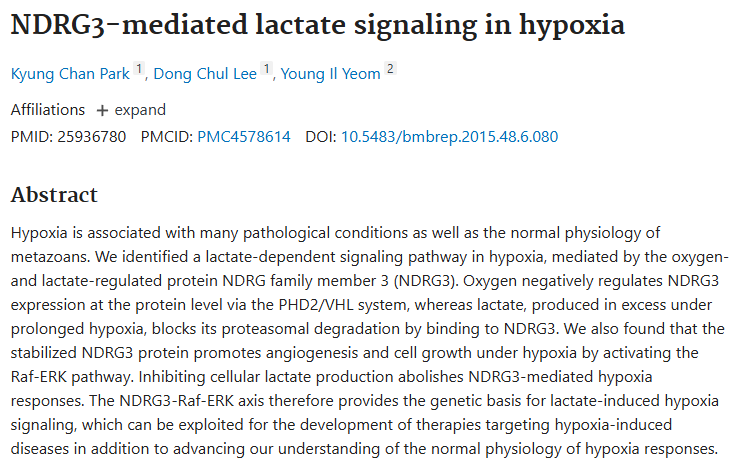
This paper demonstrated that lactate binds to the intracellular protein NDRG3 and plays a role in cellular growth and survival.
The research team compared two different conditions.
When oxygen is sufficient, cells produce energy in a stable manner. Under these conditions, the NDRG3 protein is rapidly degraded by prolyl hydroxylase (PHD2).

However, when oxygen becomes scarce and lactate begins to accumulate, lactate binds to NDRG3 and prevents its degradation. As a result, the NDRG3 protein is stabilized, which activates the RAF–ERK signaling pathway. This, in turn, promotes cell growth and angiogenesis.
In short, lactate is not simply a residue that builds up and disappears. It acts as a signal telling cells, “Oxygen is limited right now, so you need to switch to a different survival strategy." This study fundamentally reshaped the meaning of lactate.
Lactate is no longer viewed as a fatigue-inducing byproduct, but rather as a metabolic signaling molecule that drives cellular survival and adaptation.
Problems That Arise When Lactate Is Too High
Under normal physiological conditions, lactate can be beneficial for recovery and tissue regeneration. The problem emerges when lactate accumulates excessively.
When lactate levels rise too high, NDRG3 becomes overactivated, and the RAF–ERK pathway remains continuously stimulated. As a result, cells receive persistent growth signals, and if this state is prolonged, it may promote not only cancer cell growth but also malignant progression.
In other words, an environment with excessive lactate can simultaneously accelerate cellular proliferation and malignancy.
Lactate is a helper for cellular recovery, yet when balance is lost, it can become the foundation for disease—a “double-edged metabolic signal.” For this reason, maintaining lactate at an appropriate level and regulating its accumulation is considered a core strategy for safeguarding cellular health and stability, not merely a matter of reducing fatigue.
Lactate is not inherently harmful, but when it builds up too much, the intracellular environment becomes more acidic, which increases feelings of fatigue and interferes with normal cellular function. In particular, chronically elevated lactate can reduce mitochondrial energy production, increase oxidative stress within cells, and amplify muscle damage and inflammatory responses.
If lactate is not cleared quickly after exercise, muscle soreness, fatigue, and delayed recovery can occur. Over the long term, inflammatory responses may also intensify. Therefore, controlling lactate levels during and after exercise goes beyond simple fatigue management—it is a crucial process for maintaining metabolic balance at the cellular level.
This is why the speed of lactate clearance immediately after exercise becomes a key determinant of muscle recovery and fatigue relief.
Methods that support lactate removal include light stretching, contrast cold-heat therapy, hydration, massage, and wearing compression garments. Among these, compression wear is known to support muscles while improving blood flow, thereby helping lactate clear more rapidly.

A 2021 study published in Frontiers in Physiology also reported that wearing compression garments leads to a faster decline in post-exercise lactate levels.
WaveWear: Technology You Wear, Backed by Science
One product developed on the basis of these scientific principles is WaveWear.
WaveWear directly integrates the principles of kinesiology taping into the fabric itself. Through its patented silicone taping material and AlignX™ technology, WaveWear is designed to deliver the same functional benefits of taping—without needing to apply tape separately.

This structure is designed in alignment with the direction of muscle movement, helping reduce muscular oscillation during exercise and supporting blood flow, thereby alleviating lactate accumulation.
According to certified test results from the Korea Apparel Testing & Research Institute (KATRI, 2023), the group wearing WaveWear after a fatigue-inducing workout showed blood lactate levels that were on average 27–36% lower than those of the non-wearing group.
These findings indicate that WaveWear is not merely a compression garment that “holds muscles in place.” Rather, it is functional performance wear that reduces lactate buildup during exercise and improves recovery efficiency.
Lactate is not simply “the cause of fatigue.” It is a physiological signal that helps cells adapt to environmental changes and is part of the recovery process itself. The rate of lactate accumulation and clearance affects not only muscle fatigue but also cellular health.
Recent studies have shown that lactate is involved in cell growth, gene expression, and immune regulation, suggesting that “lactate management” can be more than a strategy for exercise recovery—it may be a cellular-level approach to maintaining health.
WaveWear’s AlignX™ technology is a practical application of these scientific principles in a real product, and it has been gaining attention as a new way to mitigate post-exercise lactate accumulation and support efficient recovery.
References
Lee, D. C., et al. (2015). NDRG3-mediated lactate signaling in hypoxia. Cell, 161(3), 595–608.
Li, X., et al. (2022). Lactate metabolism in human health and disease. Signal Transduction and Targeted Therapy (Nature Reviews).
Gladden, L. B. (2004). Lactate metabolism: A new paradigm for the third millennium. Journal of Physiology, 558(1).
Effects of compression garments on lactate clearance. (2021). Frontiers in Physiology.
WaveWear Internal Test Report. (2023). Korea Apparel Testing & Research Institute (KATRI).
Read next

