MOVEMENT INTELLIGENCE · 01
When you hear the term physical AI, most people think of humanoid robots. The photos featured in articles and the cases presented at investment briefings are mostly robots. However, the definition of this term is broader than that. And if you read the definition as it is, it also reveals what this field is actually blocked by.
Updated: August 2026
What exactly does physical AI refer to?
NVIDIA defines physical AI as processing multimodal inputs such as images, videos, text, voice, and actual sensor data and turning them into decisions or actions that autonomous systems can execute. Targets include not only robots and autonomous vehicles, but also fixed cameras, sensor-based systems, and physical spaces such as factories and warehouses.
The key here is not form but condition. Data should not be generated on a screen or in a server, but should come in through sensors from real-world physical phenomena. Physical AI does not require a body that walks on its own.
Why is data the real bottleneck?
Language models are trained on trillions of texts that already exist in machine-readable form. The situation is different for models that deal with the physical world. We need paired records of observations and actions, but no such data exists on an Internet scale.
Forbes summarized this gap in a June 2026 article: While the language model consumes trillions of tokens collected from the web, the Robot Foundation model is trained on less than 5,000 hours of publicly available real-world interaction data. This is because each training example must be physically collected, one at a time.
Cost is also an issue. It is pointed out that increasing the size of a dataset tenfold costs millions rather than thousands of dollars. Although synthetic data created through simulations provide scale and diversity, the current common diagnosis is that detailed movements or recovery from failure situations can only be learned from real data.
To summarize, it is like this. What is lacking in physical AI is not models, but data from real bodies.
Where does human movement data come from now?
Human movement is one of the most abundant pieces of data in the physical world. This includes the angle at which the joint bends, the order in which force is applied, and where the balance is lost. The problem is that it is difficult to consistently collect this data in daily life. There are three main methods currently used.
Camera motion capture is accurate, but the data stops at the boundaries of the space.
| way | measuring position | major constraints | Collection in everyday life |
|---|---|---|---|
| camera motion capture | Outside the body, a designated space | Limited by lighting and shooting range, and a huge burden in private spaces | difficult |
| wrist worn device | wrist | There is a distance from the joints that actually move | easy |
| Clothing with built-in sensors | above the joint | Washing durability, fit, and sensor reliability are key. | possible |
The camera is accurate but tied to space. Data is lost when you leave the lab or filming set. Wrist devices can be worn all day, but they are limited in their ability to tell how much your knees are bent from your wrist. That leaves a third option. Something that is already on your body, that is, clothes.
What will change if sensors become clothes?
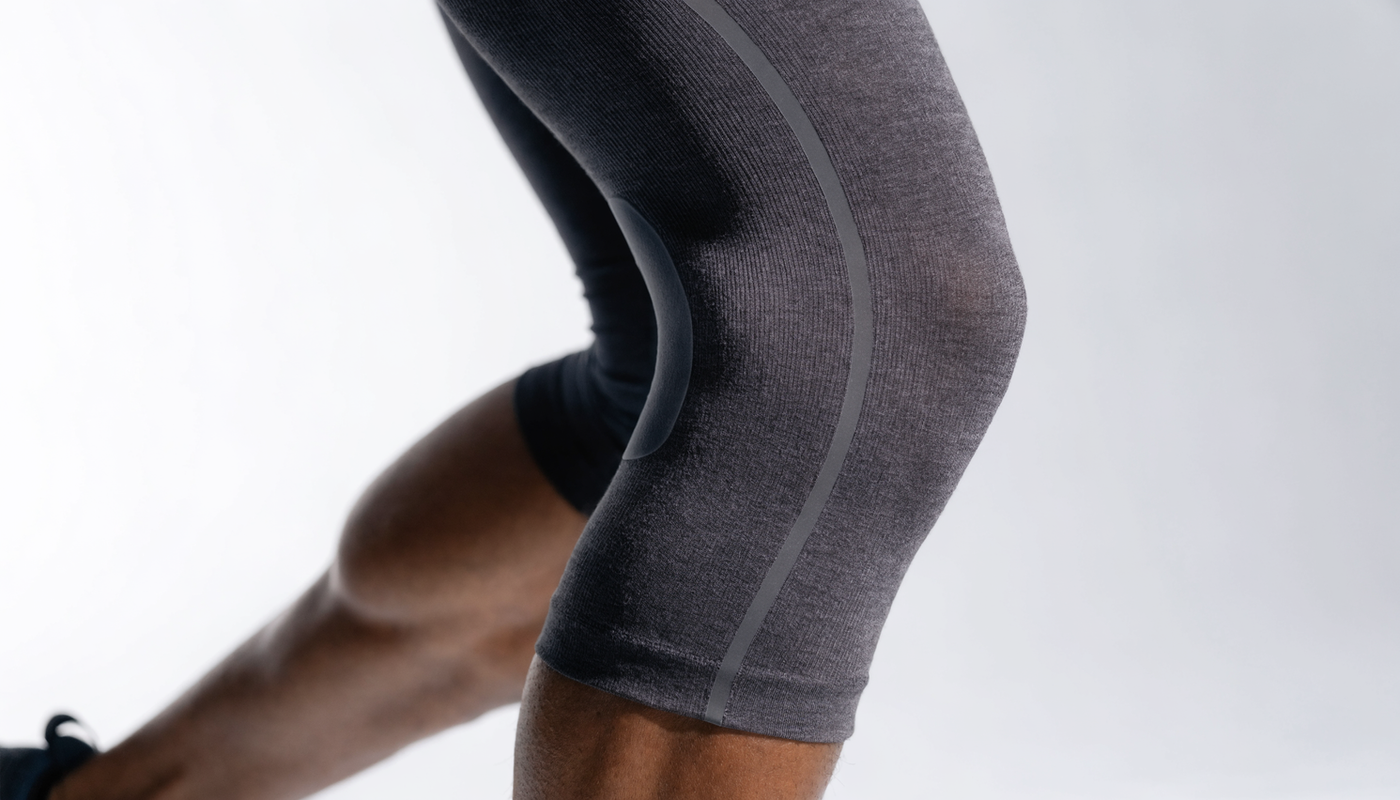
Clothing is the only interface that a person wears without being conscious of it. And it's right above the joint. If the clothing itself has sensing capabilities, the measurement point is moved to where the movement actually occurs.
Sorry, I'm not sure.
From the perspective of the team creating the product, this difference is practical. The steps for users to take the device, turn it on, and take a position are eliminated, and data is accumulated in their daily lives rather than in a designated space. Since there is no need for a camera, measurements can be made even in environments where photography is difficult, such as at home or in a hospital room.
Of course, there is a price. Clothes are washed, stretched, and worn differently on each person. Creating a sensor that will survive this is the real difficulty of this approach.
How does TracSil measure joint movement?
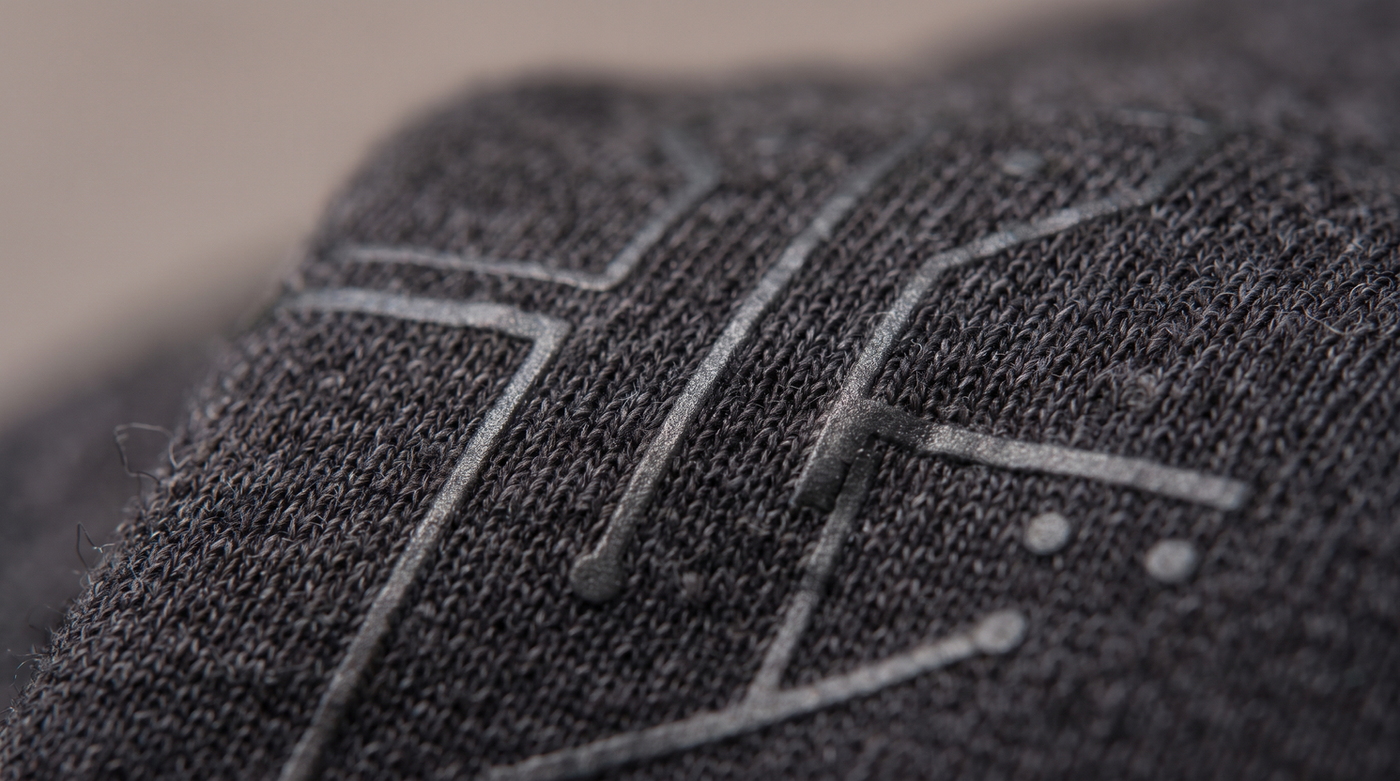
Wave Company's TracSil™ is a soft strain sensor printed on fabric. When the joint moves, the fabric stretches, and the sensor reads the stretching and converts it into angle information. No camera or separate measuring equipment is required.
Soft strain sensor printed on fabric. As the joints move, the printed lines deform along with the fabric.
Durability is a prerequisite for this approach. In our tests, the TracSil sensor withstood 10,000 repetitions of stretching from 0% to 30% at 500 mm per minute. Considering that the elongation rate that the human body experiences in daily life is generally less than 15%, it is expected to withstand more than 100,000 times under actual use conditions.
TracME™ is the translation of this sensor into a finished product. Sensors inside the braces worn on the knees and elbows record joint movements, and the app provides feedback on posture and number of repetitions based on that data. TracME was selected as the CES 2024 Innovation Award winner. The sensor itself is not sold separately. The finished product is TracME, and this is the point where the movement data coming from it is connected to other systems.
What’s possible now and what’s still being explored.
I want to know what I want to know.
What's possible now
- Recording joint angles and movement trajectories without a camera
- Check your posture in real time during exercise and automatically count the number of repetitions
- Data collection in everyday environments targeting knees and elbows
Still exploring
- Expanding the area from the joint unit to the whole body unit
- I want to know what I'm saying
- Use in clinical settings — we are currently in the validation phase with our partners
One thing to add is that TracSil is not an electromyogram (EMG). Rather than reading electrical signals from the muscles, it reads the movement of the joint through the stretching of the fabric. The two methods have different things to measure and different stories to tell.
Why this story goes beyond fitness
The place where TracME is used now is exercise. But the issues addressed here are not limited to exercise.
A method of recording how the human body actually moves over a long period of time outside the laboratory. This is a common need for rehabilitation, telemedicine, worker safety, and any system that needs to understand human movement. If physical AI is blocked from data, the first step is to expand the surface where that data can come out.
What Wave Company creates is a layer between the body and data. We don't build robots. However, any system that needs to understand real-world movement, whether a robot or a coaching app, needs an entrance for that movement to enter. We're making that entrance into a piece of clothing and putting it out there as a finished product that other systems can connect to.
Frequently Asked Questions
Does physical AI include non-robot products?
Yes. The accepted definition refers to an overall system that processes real-world sensor data and turns it into judgments or actions about the physical world. Autonomous movement is not a criterion.
Are sensors in clothing as accurate as camera motion capture?
They have different uses. The camera method has the advantage of precisely capturing the entire body in a controlled space. Sensors built into clothing have the advantage of recording long-term data at designated joints without space constraints. Rather than being a substitution relationship, the two methods cover different sections.
Can I wash it?
ElecSil™ has passed the test of over 100 washes. TracSil For washing conditions for applicable products, please follow the instructions for each product.
Does TracME measure muscle signals?
No. TracME measures joint movements and angles. It is not an electromyography method.
TracSil Can I purchase just the sensor separately?
No. TracSil is a sensing technology included in the product and is not sold separately as a part. The finished product is TracME, and this is the point where the movement data coming from here is connected to the partner.
Are you curious about which product this movement data comes from?
TracME View Link/Affiliation Inquiries
Related article
References
- Forbes, Physical AI Hits A Data Labeling Wall That Only Cash Can Fix (2026. 6. 29.)
- Highways Today, The Real Bottleneck in Physical AI and Robotics is Data (2026. 8. 19.)
This article is for general information purposes only and does not constitute medical advice.
The heart, muscles, and nerves also move with electricity. We summarize why electrical stimulation is receiving attention again amid the biohacking and longevity craze, and the story of conductive fabric, the next frontier, and ElecSil™.
Why do ‘fast muscles’ decrease first as we age? We summarize the direction of electrical stimulation research surrounding muscle loss, Dynamic FES, and the slow aging technology prepared by Wave Company.